• Ten Listening Tips – #6

    Leaders Today is affiliated with the International Listening Association. We’re pleased to share this exceptional video series to help you prepare for the International Day of Listening, to learn about and practice the skills of Listening.

    This series is a fantastic opportunity to become aware of some of your listening behaviors.

    Jean Francois had the privilege of contributing to this video series, helping to unify the look and adding extracts of his music. In his own words:

    It was fun and enlightening to discover the specific talent and approach of some of my ILA listening friends.

    We’ll be sharing these ten Tips one at a time during the few days left before the 21st of September.

    Tip#6 Look for verbal / nonverbal cues


    The whole series is also on the IDL website. Enjoy!

    http://internationaldayoflistening.com/resources/ten-listening-tips/video-of-the-week/


    Jean-François MATHIEU (jfm) September 2017

    Music composer, improviser, producer, teacher, Listening Culture Designer

    Contact, details and more about our Listen and Lead programs on www.leaderstoday.co/listen-lead

  • Ten Listening Tips – #5

    Leaders Today is affiliated with the International Listening Association. We’re pleased to share this exceptional video series to help you prepare for the International Day of Listening, to learn about and practice the skills of Listening.

    This series is a fantastic opportunity to become aware of some of your listening behaviors.

    Jean Francois had the privilege of contributing to this video series, helping to unify the look and adding extracts of his music. In his own words:

    It was fun and enlightening to discover the specific talent and approach of some of my ILA listening friends.

    We’ll be sharing these ten Tips one at a time during the few days left before the 21st of September.

    Tip#5 Listen to understand, not to respond.


    The whole series is also on the IDL website. Enjoy!

    http://internationaldayoflistening.com/resources/ten-listening-tips/video-of-the-week/


    Jean-François MATHIEU (jfm) September 2017

    Music composer, improviser, producer, teacher, Listening Culture Designer

    Contact, details and more about our Listen and Lead programs on www.leaderstoday.co/listen-lead

  • Ten Listening Tips – #4

    Leaders Today is affiliated with the International Listening Association. We’re pleased to share this exceptional video series to help you prepare for the International Day of Listening, to learn about and practice the skills of Listening.

    This series is a fantastic opportunity to become aware of some of your listening behaviors.

    Jean Francois had the privilege of contributing to this video series, helping to unify the look and adding extracts of his music. In his own words:

    It was fun and enlightening to discover the specific talent and approach of some of my ILA listening friends.

    We’ll be sharing these ten Tips one at a time during the few days left before the 21st of September.

    Tip#4 Let the speaker finish talking before you respond


    The whole series is also on the IDL website. Enjoy!

    http://internationaldayoflistening.com/resources/ten-listening-tips/video-of-the-week/


    Jean-François MATHIEU (jfm) September 2017

    Music composer, improviser, producer, teacher, Listening Culture Designer

    Contact, details and more about our Listen and Lead programs on www.leaderstoday.co/listen-lead

  • Ten Listening Tips – #3

    Leaders Today is affiliated with the International Listening Association. We’re pleased to share this exceptional video series to help you prepare for the International Day of Listening, to learn about and practice the skills of Listening.

    This series is a fantastic opportunity to become aware of some of your listening behaviors.

    Jean Francois had the privilege of contributing to this video series, helping to unify the look and adding extracts of his music. In his own words:

    It was fun and enlightening to discover the specific talent and approach of some of my ILA listening friends.

    We’ll be sharing these ten Tips one at a time during the few days left before the 21st of September.

    Tip#3 How to be an open-minded listener


    The whole series is also on the IDL website. Enjoy!

    http://internationaldayoflistening.com/resources/ten-listening-tips/video-of-the-week/


    Jean-François MATHIEU (jfm) September 2017

    Music composer, improviser, producer, teacher, Listening Culture Designer

    Contact, details and more about our Listen and Lead programs on www.leaderstoday.co/listen-lead

  • Ten Listening Tips – #2

    Leaders Today is affiliated with the International Listening Association. We’re pleased to share this exceptional video series to help you prepare for the International Day of Listening, to learn about and practice the skills of Listening.

    This series is a fantastic opportunity to become aware of some of your listening behaviors.

    Jean Francois had the privilege of contributing to this video series, helping to unify the look and adding extracts of his music. In his own words:

    It was fun and enlightening to discover the specific talent and approach of some of my ILA listening friends.

    We’ll be sharing these ten Tips one at a time during the few days left before the 21st of September.

    Tip#2 Prepare to listen


    The whole series is also on the IDL website. Enjoy!

    http://internationaldayoflistening.com/resources/ten-listening-tips/video-of-the-week/


    Jean-François MATHIEU (jfm) September 2017

    Music composer, improviser, producer, teacher, Listening Culture Designer

    Contact, details and more about our Listen and Lead programs on www.leaderstoday.co/listen-lead

  • Ten Listening Tips – #1

    Leaders Today is affiliated with the International Listening Association. We’re pleased to share this exceptional video series to help you prepare for the International Day of Listening, to learn about and practice the skills of Listening.

    This series is a fantastic opportunity to become aware of some of your listening behaviors.

    Jean Francois had the privilege of contributing to this video series, helping to unify the look and adding extracts of his music. In his own words:

    It was fun and enlightening to discover the specific talent and approach of some of my ILA listening friends.

    We’ll be sharing these ten Tips one at a time during the few days left before the 21st of September.

    Tip#1 Value Listening


    The whole series is also on the IDL website. Enjoy!

    http://internationaldayoflistening.com/resources/ten-listening-tips/video-of-the-week/


    Jean-François MATHIEU (jfm) September 2017

    Music composer, improviser, producer, teacher, Listening Culture Designer

    Contact, details and more about our Listen and Lead programs on www.leaderstoday.co/listen-lead

  • Self-leadership, a buzz word or science?

    Self Leadership Text 2 800x533

    Self-Leadership…….   it sounds like just another management buzz word, doesn’t it?

    Actually, self-leadership is a very well-researched concept that proposes specific and practical cognitive strategies to improve personal effectiveness. It is a tested process by which individuals can learn to influence themselves to achieve their aspirations and objectives.  Self-leadership theory is particularly interesting because it is prescriptive and provides concrete, specific strategies on exactly what to do to develop constructive mental habits, improve performance and create a fulfilling work life.

    Many workplace problems are resolved by developing self-leadership skills.  From increasing job satisfaction, tackling procrastination, developing a solution-focused approach, or consistently achieve goals.

    At this stage most readers would want to know, is this useful for me? Is it worth reading this article?  I would say Yes!

    Many people plod on in a dissatisfying job and do not know how to change the situation. They might just work harder and harder, risking a burn out, or they might rely on external forces (the boss, the company, a stroke of good luck) to provide a solution. They are likely to underestimate the power they have to influence their own life and career, so…. if you’re looking to empower yourself, read on!

    In this article, I will describe the three main categories of self-leadership strategies (Neck, Manz and Houghtoun, 2017) and make parallels with coaching approaches. I will then visit the concept from a coaching perspective and briefly present the Leaders Today self-leadership model.

    Origins of Self-Leadership Theory

    The concept of self-leadership, expanding on previous theories of self-management, first emerged in the 1980’s in the work of Charles C. Manz (1983, 1986). Its conceptual foundations lie in social cognitive theory, self-determination theory and positive psychology. It has been further developed over the years by Manz himself and other renowned leadership scholars and practitioners including Christopher P. Neck, Jeffrey D. Houghton, Henry P. Sims and Ken Blanchard, who applies it through his Situational Leadership model.

    The initial studies were conducted in the United States, under a Western lens. However, in a globalised world where many people are working in multicultural contexts, it was necessary to clarify and make sense of how self-leadership is understood across cultures. Research by José C. Galvez, who investigated self-leadership along Hofstede’s culture dimensions has been invaluable to determine how self-leadership strategies are applicable by people from different cultural horizons to provide excellent results across the board.

    Discussions about self-leadership were first developed around the workplace, to investigate how people could influence themselves as a sort of pre-requisite to then influencing or leading others.  It quickly became obvious that self-leadership strategies are powerful personal development tools irrespective of whether you lead others or not.  Furthermore, they are beneficial in all aspects of life, not only in the professional sphere.

    Self-leadership strategies

    The Self-leadership model developed by Neck, Manz and Houghton (2017) consists of three categories of cognitive strategies as follows.

    Constructive thought patterns

    Developing constructive thought patterns is essential to implementing self-leadership.   We know from different approaches in psychology, that our inner mental models determine what we perceive from the external world, how we think about it, what feelings are evoked, what behaviours we adopt and consequently, the results that we produce.

    Much like in cognitive behavioural coaching, self-leadership strategies help to identify and replace limiting beliefs and assumptions, they tackle and transform dysfunctional thought patterns such as overgeneralising, always expecting the worst, all or nothing thinking, or systematically discounting the positive.

    They also help you to work on your expectations, or imagined experiences, by focusing more on possible positive outcomes rather than speculating on hypothetical negative ones.  Mental imagery is also widely used in coaching to visualise a future positive performance because it prepares the whole human system to the achievement of the desired successful result.

    Finally, having constructive thought patters leads you to improve on the quality of your inner dialogue, and transform it into positive self-talk.  In coaching we acknowledge the inner critic, knowing that it is often the manifestation of fear or anxiety. The goal then is to reassure and pacify this function of our inner world and transform it into an inner helper instead.

    Natural reward strategies

    Self-leadership strategies harness the power of natural rewards, they help you do what you want to do, and especially find ways to like the tasks you wouldn’t usually enjoy.  Charles Manz found that activities which are naturally rewarding are those over which we have control, that make us feel competent, that are somehow pleasant, and make us experience a sense of purpose.  The idea is to modify our tasks by including more naturally rewarding aspects in them, for example you might identify what is the higher purpose of the task, what bigger picture it contributes to, or you can appreciate using the specific skills that you have to accomplish it, or you could improve the work space where you are undertaking the task.

    Most activities have pleasant and less pleasant aspects. A powerful self-leadership strategy, which may sound simplistic at first, is to systematically choose to focus on even the smallest enjoyable aspect of a task, rather than focus on what you don’t like.

    In coaching, several techniques are used to help the client see things from a different perspective, find the positive in the negative and generally develop a more optimistic outlook that will remove blockages and release the energy needed for taking action.

    Behaviour-Focused strategies

    A first group of behaviour-focused strategies are oriented towards the external world and include making adjustments to your environment to support any behavioural changes that you are working on. For example, if you are tackling a tendency towards procrastination, it’s important to remove distractions, and instead increase positive cues by creating a pleasant work space, placing physical objects as reminders and having the right resources near at hand.

    The second group of behaviour-focused strategies operate at a deeper level on your inner world, to increase self-awareness, motivation, direction and proactiveness.  They involve finding a sense of purpose by exploring your true aspirations, setting meaningful and achievable goals, observing yourself to monitor your progress.   Lastly, there are specific behaviour-focused strategies to reward yourself when you accomplish even a small step ahead, and maybe more importantly to remove the rewards that encourage undesirable behaviour (of which we are generally not aware).

    These strategies are reflected in most coaching processes which would start by helping an individual to define their vision or life purpose, identify a career course that matches it and devise an action plan to achieve it.  This inside-out approach is typical in coaching, where we leverage the inner motivation of clients to energise them towards taking action.


    Self-leadership from a coaching perspective and the Leaders Today model

    Coaching is generally understood to be a non-directive approach in which learning occurs by stimulating the client to reflect on herself and find new perspectives to view the world. The aim of coaching is to cause a change of some sort by creating the conditions for the client to achieve their goals.  Coaching thus starts with a client who wants something (a concrete objective, or an inner transformation or both), and continues through a process during which the client is increasingly empowered, so that they can autonomously achieve their goal.

    Many of the strategies of self-leadership are also used in coaching, where we call them approaches, or tools.   Although coaching has built its own body of knowledge in the last 20 years, it has its origins in diverse disciplines such as psychology, management, sports and philosophy which explains why we share some of the foundations of self-leadership theory.

    From a coaching perspective, we would more explicitly highlight the importance of developing self-confidence, and provide tools to this effect, including acknowledging one’s strengths and leveraging past successes.

    Coaching is both a holistic and a systemic practice, so clients are viewed as a whole (body, mind and emotions), and also within the wider system of their personal and professional environment.  In this sense, the development of self-leadership skills consists of not only the cognitive but also the emotional and somatic dimensions of the individual.  This means enhancing emotional self-management, working on body language and techniques for dealing with stress.   A coaching approach also includes tools that help the client interact successfully with the system they work in. This entails reinforcing assertiveness, honing communication skills, developing the ability to influence others in a positive way and enhancing leadership presence, or the way we show up authentically and authoritatively.

    The Leaders Today model for developing self-leadership skills thus consists of four stages which can be worked on cyclically:

    • Vision – be strategic and proactive in choosing and pursuing your direction
    • Confidence – strengthen your self-confidence and positive outlook
    • Presence – enhance your leadership presence and show-up
    • Influence – communicate with others for win-win outcomes


    Self-leadership Graphic with Arrows


    We conduct workshops on self-leadership and also integrate it in our Executive Coaching programmes as key development areas leaders in senior positions.

    Contact us for more information  :

    contact @ leaderstoday.co


    References

    • Alves, José C.; Lovelace, Kathi J., Manz; Charles C.; Matsypura; Dmytro; Toyasaki, Fuminori; Ke, Grace; 2006,  “A cross‐cultural perspective of self‐leadership”, Journal of Managerial Psychology Vol. 21 No. 4, pp. 338-359.
    • Cox, Elaine; Bachkirova, Tatiana; Clutterbuck, David; (Eds), 2014, “The Complete Handbook of Coaching“, SAGE Publications.
    • Manz, Charles C., 1986, “Self-Leadership: Toward an Expanded Theory of Self-Influence Processes in Organizations”, Academy of Management Review, Vol. 11, No. 3, pp. 585-600.
    • Neck, Christopher P.; Houghton, Jeffry D.  2006, “Two decades of self‐leadership theory and research: Past developments, present trends, and future possibilities”, Journal of Managerial Psychology, Vol. 21 No. 4, pp. 270-295.
    • Neck, Christopher P.; Manz, Charles C.; Houghton, Jeffry D., 2016, “Self-Leadership – The Definitive Guide to Personal Excellence”, SAGE Publications.



    Saba Imru-Mathieu(180x180)

    ©2016 Saba Imru-Mathieu, Founding Partner, Leaders Today

    Saba Imru-Mathieu is an Executive Leadership Coach and Senior Coach Trainer who works with global organizations.  She holds a Masters degree in leadership studies and her current doctoral research focuses on how coaching capabilities contribute to global leadership.

    www.leaderstoday.co
    Sign up to our free newsletter to get leadership and coaching tips

  • So many books on coaching! What to read?

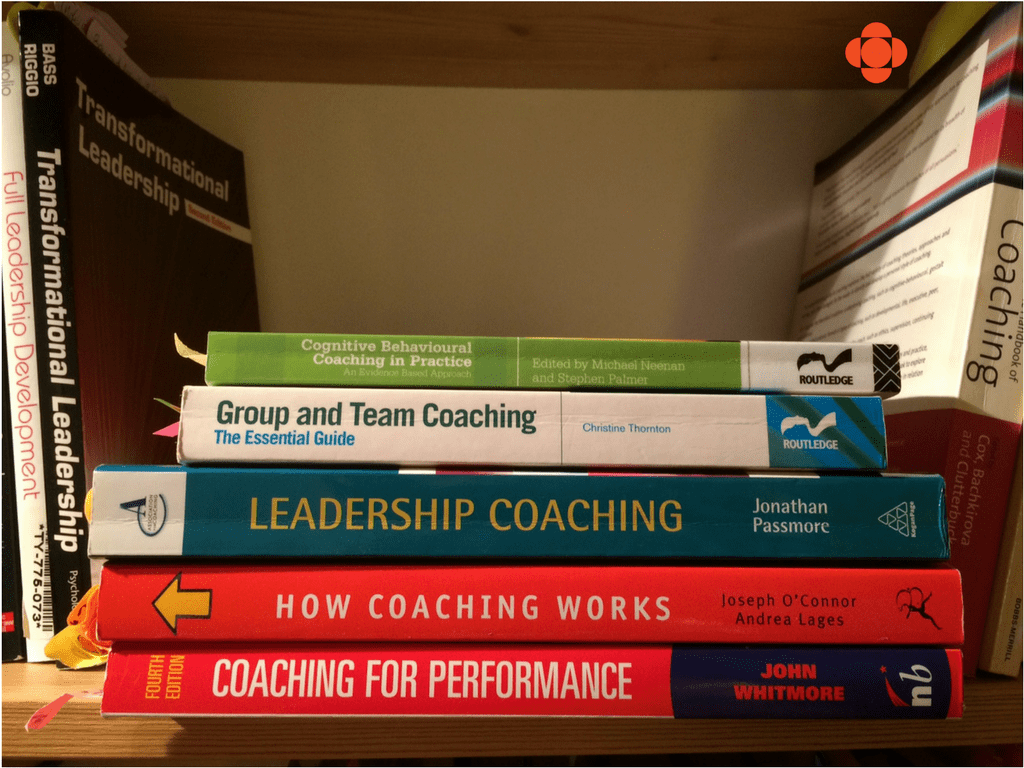
    Bookshelf

    There are so many books about coaching and it’s quite hard to navigate through all the titles to find what really matches your needs. I can’t claim to have read everything there is to read about coaching, but here are a few tips from my bookshelf.

    If you are new to coaching, or just curious to know what all the buzz is about, I would suggest these two introductory books.

    Coaching for Performance,  Growing human potential and purpose, by Sir John Whitmore, one of the pioneers of coaching in the UK, was first published in 1990 at a time when there were not many books on coaching, and research in the field was still scarce.   It is written from a practitioner’s perspective and has the merit of having introduced coaching as a management style that could be used to transform workplaces into values-driven and more humane enterprises.  Sir John explained the nature and process of coaching, and popularized the now famous GROW model which was initially developed by Graham Alexander a decade before.


    How coaching works, by Joseph O’Connor and Andrea Lages is a very good overview of coaching, where it comes from and how it developed into a vastly popular profession. The authors present the history of coaching, portraying the key players in the US and in Europe who were at the rise of this new profession starting from the 1970s, and they note the social and environmental factors that enabled the emergence of coaching in the 20th century. They describe the various multidisciplinary influences on coaching and describe some of the most well known approaches, such as integral coaching, ontological coaching and NLP, as well as presenting their own integrated model. A very good read that familiarizes you with the profession.


    If you are a coaching professional, and are looking for specialist texts, I would recommend these research-based books that provide sound knowledge and practical models of coaching that you can use immediately.

    Leadership Coaching, Working with leaders to develop elite performance, edited by Jonathan Passmore is a must-have on your bookshelf if you work with executives and senior officials. This collection of contributions by eminent scholars and practitioners covers all the key topics of leadership coaching, such as authenticity, emotional intelligence, derailing leadership and transformational leadership. The book presents research-based techniques and models that will help you to develop leaders  in many different contexts, from strategy coaching to working with political leaders or global teams.


    Group and Team Coaching: The Essential Guide, by Christine Thornton is really a treasure trove of information, knowledge and practical guidelines on how to coach groups and teams. The author unbundles the processes of group dynamics and how  these play out in a coaching situation. She also explores the life of groups from a systems perspective giving plenty of tips on how to work within complex organizational environments.  Lastly, she gives guidance on how to tackle problem behavior in group settings.  I found it to be an excellent, highly practical read, based on solid research.


    Cognitive Behavioural Coaching in Practice, edited by Michael Neenan and Stephen Palmer presents a theoretical model that aims at understanding and changing inner blockages, together with lots of tools to address various coaching topics, for example building resilience, managing stress, reinforcing self-esteem and enhancing performance.  The authors present many vignettes and sample coaching dialogues to illustrate their models. Each chapter ends with a long list of references if you want to read further on the subject.


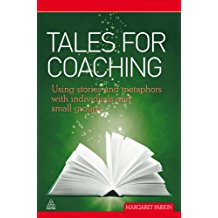
    Lastly, if you like using stories and metaphor in your coaching, this book for you!

    Tales for Coaching

    Tales for Coaching, Using Stories and Metaphors with Individuals and Small Groups, by Margaret Parkin. The first part of the book presents the history, purpose and benefits of story-telling and how these can have a transformative effect on how coaching clients develop a new narrative about their situation. The second part is a collection of poems and stories that you can readily use or adapt in your practice.   It is an excellent resource for both corporate and life coaches.


    Happy reading!

    I would love to hear back from you if read these books, or if you have any other books on coaching that you’d like to recommend.  Please put your comments in the text box below!


    Saba Imru-Mathieu(180x180)

    Saba Imru-Mathieu is an Executive Leadership Coach and Senior Coach Trainer who works with global organizations.  She holds a Masters degree in leadership and her current doctoral research focuses on how coaching capabilities contribute to global leadership. She is the co-founder of Leaders Today, a coaching and consulting firm based in Geneva, Switzerland.

     www.leaderstoday.co       

  • Something really easy you can do to be a better leader at work

    Easy steps for leadership

    Sometimes when running leadership development programs we teach the simplest of things. We find ourselves resuscitating fundamental knowledge that people already have within themselves at a deep, core, human level but which somehow got buried in the desert of organisational life.

    So here it is…..


    Effort:  3 extra minutes of your time
    Requirement: absolute sincerity

    Benefit 1: connect with others at a human level
    Benefit 2: develop warm and trusting relations
    Benefit 3: be a nice person (“nice” is neither a weakness nor a derogatory adjective)
    Benefit 4: be likeable (essential for a leader who wants to positively influence others)

    Method – What: Ask a sincere”How are you?” when running into a colleague, and expand on it.
    Method – How:  Smile, care, give time for a response and listen

    Example:

    You: Hi Dave, how are you today?

    Dave: Fine thanks.

    You: And how are the kids doing? (or anyone / anything else the person cares about: the person’s gardening, a golf tournament, a project at work)

    Dave: Well actually they’re fine, the youngest is…… and the eldest…….

    You: Give an appropriate response acknowledging what the person said (That’s wonderful, or I’m sorry to hear that).  Engage in a brief exchange if it’s appropriate, then wish them well (Keep it up, or I hope it gets better).  Say goodbye and wish them a nice day.

    That’s it.  It’s as simple as that.

    Do this regularly. This is what successful leaders do. They sincerely care about the people around them and they demonstrate it in the simplest of ways. In turn people like and trust them.  More importantly, they are willing to follow them and make efforts to achieve common goals.   Remember that the most sophisticated strategies cannot be realized unless there is engagement by those that have to implement them, and people won’t engage fully unless they feel recognized as a human being.

    Beware!: Mental models that might undermine your aptitude to leadership and influence (but that you can change!)

    • Thinking that you are too busy to demonstrate sincere concern for your colleagues
    • Thinking that you will look feeble
    • Thinking that at work you don’t need to care about people to get the job done
    • Thinking that showing that you care about your people is indiscrete or intrusive
    • Thinking that being nice is dumb

    Oh, and by the way, if you just can’t bring yourself to sincerely care about others at work, forget about being an effective leader.

    www.leaderstoday.co


    Saba Imru-Mathieu(180x180)

    Saba Imru-Mathieu is an Executive Leadership Coach and Senior Coach Trainer who works with global organizations.  She holds a Masters degree in leadership and her current doctoral research focuses on how coaching capabilities contribute to global leadership.

  • Why companies train their managers to have coaching skills

    coaching skills for managers

    Increasing the availability of coaching inside companies

    Coaching used to be largely reserved for executives and senior managers for whom an external professional coach would be hired to help them advance in various aspects of their leadership function.  Coaching is an exclusive, highly customized learning and development experience, driven by the client’s goals, which explains why companies were willing to make the investment only for a selected number of employees.

    Several industry research papers, including those published by the International Coach Federation, have measured the benefits of receiving coaching and the return on investment is excellent, sometimes exceptional depending on how it is calculated. Findings show that employees at varying organisational levels who receive coaching improve performance and business management skills, increase productivity and motivation, sharpen their problem-solving skills,  they become more autonomous and proactive, and develop an overall more positive attitude which in turn positively affects the organizational climate.

    Given all these remarkable benefits, companies are increasing the availability of coaching for a wider segment of their workforce by creating roles for internal coaches, usually HR professionals who provide full coaching services, and by training managers to integrate coaching skills into their leadership style.

    The characteristics of Managers who coach

    Coaching by managers is quite different from what professional coaches do.  First of all they don’t have coaching clients as such, they coach their team members or other colleagues.   Secondly, while a professional coach has no agenda other than the client’s goals, a manager has to balance the team member’s goals, organisational goals and their own goals as the person responsible for the team results.  Managers also have to engage with employees in different ways besides coaching, depending on the situation. There are times when it is more appropriate to teach, for example when wanting to transmit technical skills, or give clear directions, when there is an emergency and quick decisiveness is needed.

    Once they have learned coaching skills, managers tend to use a “coaching leadership style” most of the time. There are good reasons for this.

    Here are three of the greatest advantages.

    SAVE TIME

    Managers who coach, develop their team members’ capabilities, rendering them more independent.  By  using coaching techniques, they support their staff to learn quickly, find their own solutions and solve problems more effectively.   A manager who is a bit more controlling and prefers to have the monopoly of all the answers, ends up unwittingly grooming people to repeatedly ask for solutions and directives. This becomes highly time-consuming and an energy drain for the manager.

    Instead the coaching manager facilitates learning and the empowerment of staff within their role.   When people feel more capable, they become more autonomous and able to take responsibility. They get on with it, without having to constantly ask for guidance. This of course saves a great deal of time for the coaching manager.

    BOOST PERFORMANCE

    A coaching manager focuses on what employees can already do and helps them leverage their existing strengths to achieve new goals.  A strengths-based approached, rather than a deficit-oriented one, has a positive impact on performance because the focus is placed on reaching outcomes using existing capabilities rather than spotting weaknesses. There are usually different ways to accomplish a task and if an employee can go about it using their existing strengths, they will produce quicker and better results. Gallup have specialized in creating strength-based cultures worldwide, boosting employee performance to a level where companies  have been able to achieve as much as 29% increase in profits, and a reduction of employee disengagement to as low as 1%.

    BRING A POSITIVE DIMENSION TO WORK RELATIONS

    Coaching rests on a number of assumptions that foster a positive working environment, starting with a favourable outlook on people and their potential to grow. Coaching managers treat employees as individuals and support their development becausethey believe it is beneficial for everyone: the person, the team and the organization.

    Coaching managers reinforce good performance by generously giving factual positive feedback. Even when they have to give negative feedback, managers who are trained in coaching skills are able to deliver it in the most constructive way, making it acceptable and allowing employees to find their own remedial solutions towards improving their performance.

    Learning coaching techniques also develops interpersonal skills, such as effective listening, empathy and the ability to build  trusting relations.  So by using a coaching approach, managers inevitably bring a warmer human touch to working relations.

    *****

    Is coaching for everyone?

    There are of course limitations and weakness.  Not everyone is “coachable”. Some people are not motivated to learn, nor are they inclined to reflecting on their work.  Also, not everyone has the temperament or wants to be a manager coach, which requires a willingness to let go of some control and to help others develop.  Coaching requires a precise skill-set so training has to be of such a quality that it will enable managers to easily deploy coaching as needed and differentiate between the various aspects of their role (supervising, directing, teaching, mentoring, coaching).

    Coaching, the leadership style for the 21st century

    In conclusion, organisations that adopt a coaching culture and train their managers to exhibit coaching skills have found a highly effective leadership style that produces excellent performance results while also improving organisational climate.

    The demise of the traditional command and control mode left a vacuum. Manager are unsure of what ideal management behaviours they should display on a daily basis. From management by objectives, to vague notions of  democratic or participatory leadership, to supposedly horizontal organisations, managers have been at a loss on what they should actually do in practice to empower employees while still controlling outcomes for which they are held accountable.

    Developing coaching skills is an elegant way to resolve this dilemma. Managers who coach have a leadership style that is adapted to the 21st century with its workforce that expects to be valued,  empowered and actively involved in the greater purpose of the organisations they work for.

    *****

    What is your experience with coaching?  Have you received coaching at work, or are you a coaching manager?  Share your views with us in the comment box!

    *****

    © 2017 Saba Imru-Mathieu 

    Learn more about our Coaching Skills Training for Leaders and Managers

    Learn more about our Coaching Culture Program

    www.leaderstoday.co


    24verysmall - Copy

    Saba Imru-Mathieu is an Executive Leadership Coach and Senior Coach Trainer who works with global organizations.  She holds a Masters degree in leadership and her current doctoral research focuses on how coaching capabilities contribute to global leadership.