“Leader Coach Tutorials” Video Series.
Coaching is about having the right supportive mindsets, as well as displaying excellent communication and coaching skills. Adopting a positive, humane, winning, mindset will help you be a better leader coach.

Coaching is about having the right supportive mindsets, as well as displaying excellent communication and coaching skills. Adopting a positive, humane, winning, mindset will help you be a better leader coach.

Mais quelle question! Ne sommes-nous pas constamment confrontés à un territoire inconnu de nos jours?
Les étudiants ne savent pas si ce qu’ils apprennent maintenant sera utile le jour où ils arriveront sur le marché à la recherche d’un emploi. Les marchés sont tellement changeants que ceux qui ont un travail se posent parfois des questions sur la stabilité de leur emploi. Les gestionnaires ne savent pas vraiment ce que l’avenir à long terme leur réserve, pour eux-mêmes, pour leur équipe, pour leur entreprise. Les parents ne peuvent pas imaginer à quoi ressemblera le monde quand leurs enfants seront adultes, les météorologues ne peuvent même pas nous dire si notre ville sera encore au-dessus de l’eau dans 20 ans et hélas – la plus grande des incertitudes – personne ne sait combien de temps il vivra, ce qui fait de la planification à long terme plus un exercice de vœu pieux que toute autre chose.
Peut-être que la peur du changement est juste une invention moderne, une expression de l’angoisse des économies avancées qui voudraient, bien entendu, ne pas être affectées par les vicissitudes d’un univers imprévisible.
La capacité de vivre sans connaître le futur et d’accepter un changement inattendu sont des capacités clés que l’humanité a déjà maîtrisées, il y a très longtemps! C’est cette flexibilité qui nous a permis d’être ici aujourd’hui.
De l’homme des cavernes à l’analyste de Wall Street, personne n’a encore été capable de prédire infailliblement la disponibilité du gibier dans la brousse, ni le cours des stocks sur le marché. L’état naturel des choses est de ne pas connaître le futur. Depuis la nuit des temps nous vivons avec cette ignorance existentielle. Face à l’inconnu, les humains ont composé aussi gracieusement que possible avec la réalité inéluctable du changement constant. Ceci jusqu’aux temps modernes, quand il nous semble avoir étrangement perdu cette capacité. Aujourd’hui, nous avons peur du changement, entrer dans un territoire inconnu nous semble effrayant et insupportable, plutôt que le cours normal des événements.
L’incertitude et le changement ne sont pas un phénomène nouveau. La complexité et l’imprévisibilité que nous connaissons aujourd’hui ne sont en fait rien de nouveau, ils ont toujours été là. L’univers est complexe, la vie humaine est complexe et rien n’a jamais été écrit dans la pierre.
Malgré l’hystérie autour du changement, il n’est pas si effrayant et en tant qu’espèce, nous avons toujours réussi à naviguer dans des conditions imprévisibles. Nous avons fait preuve de résilience et de créativité même dans les situations les plus difficiles.
Que les gens résistent au changement est un mythe, les humains s’adaptent constamment aux surprises de la vie!
Calmez donc vos peurs, détendez-vous et partez hardiment dans l’inconnu, comme nos ancêtres, pour découvrir les trésors que la vie nous offre!


This fascinating book by Christine Thornton, is excellent for practitioners, leaders and students of coaching who want to understand group dynamics, systems thinking and other crucial concepts and techniques needed to successfully coach groups and teams.

Apprendre les outils de coaching
Pour la plupart des coachs, une introduction à l’exercice de notre profession a commencé par l’apprentissage d’un outil de coaching. Le coaching est un comportement et une expérience. La seule manière de le comprendre est de le pratiquer. Il n’y a rien de mieux qu’un outil de coaching pour commencer à faire du coaching ! Et, une fois que nous l’avons fait, nous sommes étonnés de voir à quel point il peut sembler simple d’aider les clients à acquérir de nouvelles perspectives, à ouvrir de nouvelles pistes de réflexion et à avoir plus d’espoir dans la vie.
Vous souvenez-vous de la première fois où vous avez utilisé la Roue de la Vie avec un client, ou un exercice de valeurs, ou une ligne de questions d’après GROW ou un modèle similaire ? Ce sont des moyens si inhabituels pour engager une conversation sérieuse qu’ils ont invariablement un impact énorme sur nos clients ! Bien sûr, il ne s’agit pas seulement de manipuler des outils de coaching, nous apprenons également à créer un rapport et nous développons les fondements éthiques qui créent une relation de confiance solide avec notre client. Néanmoins, quel que soit le type de formation que nous avons eue, la première période de développement d’un coach professionnel est largement dédiée à l’acquisition d’un certain nombre d’approches de coaching et de nombreux outils de coaching !
La relation de coaching
Au fur et à mesure que nous acquérons plus d’expérience, nous réalisons qu’il y a quelque chose de plus que les outils. Ils ne sont que la partie visible de l’iceberg et nous constatons que, ce qui se passe réellement dans une relation de coaching, est une connexion au plus profond de la relation entre deux êtres humains, l’un cherchant et l’autre soutenant.
Ce lien n’a pas grand-chose à voir avec les outils de coaching, c’est le résultat d’une relation fondée sur des valeurs humanistes, un regard positif inconditionnel sur nos clients et la conviction qu’ils ont tout le potentiel dont ils ont besoin. C’est aussi le résultat d’une résonance limbique positive – la capacité inconsciente à lire et à s’adapter aux émotions des uns et des autres – qui se développe avec le temps entre deux humains dans une relation de confiance.
La recherche en psychothérapie indique que la relation entre le thérapeute et le client a plus de poids que toutes les techniques dans l’établissement de changements positifs. Ce concept a été transposé dans le contexte du coaching, en particulier par le spécialiste et praticien Erik de Haan, et son approche du « coaching relationnel », qui donne une lecture profonde et enrichissante de ce qu’est le coaching.
Trouver un équilibre judicieux dans notre pratique du coaching
Donc, si les outils ne sont pas la véritable cause du succès du coaching, devrions-nous à un certain moment dépasser les outils ? Est-ce un signe d’un coach “mature” ? Pas d’outils, juste une conversation profonde ? Je ne le pense pas ! Je trouve que les outils de coaching sont des raccourcis merveilleux qui peuvent parfois être très utiles pour aborder directement l’aspect essentiel des choses. Par exemple, demander à un client de dessiner une situation qu’il ne semble pas capable de verbaliser peut être très efficace pour révéler ce qui se passe réellement pour lui. Ou utiliser une approche de questionnement structurée pour la fixation d’objectifs peut être très efficace pour donner forme à des idées qui peuvent être éparpillées au départ. L’idée n’est pas de se limiter aux outils pour faire le travail. Ils ne sont qu’un moyen d’atteindre le résultat.
Certains de mes étudiants en coaching me disent qu’ils n’aiment pas vraiment utiliser des outils, ils préfèrent s’en tenir à l’approche conversationnelle du coaching. Je leur répète infailliblement que s’il s’agit d’un choix conscient et délibéré de se concentrer uniquement sur l’aspect relationnel, c’est bien, mais s’ils évitent d’aller au-delà du mode conversationnel parce qu’ils se sentent mal à l’aise ou manquent d’audace à utiliser les outils, alors ils pourraient passer à côté des possibilités – pour eux-mêmes et leur client – d’expérimenter différentes manières de communiquer, de voir les choses et de produire des résultats lors de la session de coaching. D’autres étudiants se cachent derrière des outils, en déploient un ou plusieurs à chaque session et évitent ainsi l’apparente nudité d’être juste eux-mêmes avec leur seule présence, au service du client. Dans ces cas, l’audace du coach signifierait de laisser tomber tout ce qui se trouve entre elle et son client, que ce soit une table, un bureau ou un outil de coaching !
Lors de l’utilisation d’un outil, assurons-nous que nous le maîtrisons
Une relation de confiance est évidemment la première chose à faire, mais les outils de coaching sont également utiles à condition que le coach les maîtrise. Je veux dire par là que vous devez aller au-delà de l’utilisation d’un outil. Il y a tellement d’outils de coaching disponibles dans les cours de coaching, dans les livres, sur le web, mais tous ne sont pas accompagnés d’une explication de comment ils ont été développés. Pour maîtriser un outil, il est très important de comprendre les connaissances et les concepts sur lesquels il repose. Pourquoi est-ce comme ça ? Quel approche coaching reflète-t-il ? Qui l’a inventé ? A quoi pensaient-ils ? Quelle est sa fonction ? Pourquoi fonctionne-t-il ? Est-ce que ça marche toujours ? À quelle fréquence cela fonctionne-t-il pour vos clients ? Dans quelles circonstances ? Ce niveau de maîtrise vous permettra d’adapter rapidement les outils spécifiques à votre client, de les utiliser de manière limitée, sage et efficace, et surtout de les ignorer quand ils ne sont pas nécessaires.
________________________________________
© 2017 Saba Imru-Mathieu

Saba est co-fondateur de Leaders Today. Elle est Executive Leadership Coach and Senior Coach Trainer travaillant avec des organisations à l’échelon mondial.


Many people ask me why I call our training program Leader Coach while other coaching schools refer to Manager Coach instead. I think the choice of the term depends on what your view of leadership is.
The first reason that I prefer the term “leader coach” rather than “manager coach” is that management is associated with ensuring that processes work properly, bringing order, organizing and controlling. Whereas leadership is associated with dealing with people, creating a vision, establishing trusting relations, motivating, empowering others. John Kotter wrote a ground-breaking paper in 1990 called “What leaders really do” on the difference between the roles of leader and manager, how both are necessary in the working world and how everyone can become proficient in both.
When you look at what coaches do, talking with people, developing talent, empowering others and helping them be accountable, it is much closer to leadership than management. The competencies required for coaching overlap with those of effective leadership, for example, self-management and emotional intelligence, or advanced communications skills such as listening, reflecting, questioning.
Of course, most professionals do both, a bit of leading and a bit of managing, but when they coach it’s a distinct aspect of the way they express their leadership. In a certain sense, you can see coaching as being a leadership style.
Many people are still attached to an early concept of leadership. The studies at the beginning of the 20th century portrayed leaders as being greater-than-life figures, with specific innate traits that enabled them to have a strong influence on a loyal following. Although this model is generally considered outdated in the world of leadership studies, the myth of the super-human leader remains in the back of people’s minds. It has a certain fascination about it. There’s a widely-held assumption that you need special characteristics, or you must have a high-level position to be a leader.
This means that most employees are reluctant to identify with the word “leader”, they might feel it is pretentious or at least a bit inflated, or simply that they don’t have the “level” or “power” to be a leader. If this is your view of leadership, then the term “manager coach” probably feels less threatening, more comfortable!
I like to push back against this because I want to encourage everyone to recognize their leadership capabilities, irrespective of their professional position. I think everyone, individuals, and companies would benefit from this recognition of talent.
In line with many contemporary leadership theories, I believe that leadership does not belong only to some people at the top of a hierarchy. Everyone expresses leadership at different moments at work or in life in general. So, while it’s true that some people have ongoing leadership responsibilities as part of their job, others may be called upon to express their leadership at given moments, for example, if they have to lead a project, or if they suddenly have to mobilize a number of colleagues to solve an urgent problem. All of us can cite an example of someone we know who suddenly rose up to the occasion, or who is highly influential without being a classical “boss”.
I remember in a company where I was working on culture change, I asked who the most influential person was, other than the CEO. It turned out to be the head of the client-care desk. This line-manager was so positive, client-oriented and dynamic, that she had built a reputation for being a problem-solver. Senior executives from client companies would contact her directly to ask for a tip or a connection, and she would always find a solution or get other colleagues to find one.
The notion of leader has expanded from someone in an appointed position, like a chief of a department, to someone who has the ability to positively influence others to take action, maybe just for a given time, irrespective of their hierarchical position.
Most importantly we now know that leadership, including the ability to coach – which is a key leadership skill – can be learned and constantly improved upon!
Many studies show that professionals who already have leadership responsibilities find that learning how to coach helps them enormously to improve the quality of their relations at work, to boost their own confidence as individuals who can live in accordance with their values and contribute meaningfully to their work environment.
Here’s what Paul A. Stodden, Group President of Siemens, cited in Making Coaching Work by Clutterbuck & Meggison, 2005, says about the impact of professionals having learned to coach in their company.
“We have experienced that continuous pressure on hard factors produces limited long-term results, while coaching helps break down barriers to trust and to manage increased complexity as well as encouraging a mutually supportive culture. In this way, it directly supports our business success.”
Wherever you are on your journey, I hope you feel confident that you are already connected with your innate leadership capabilities, and that you can develop them further by learning how to coach at work!
JOIN OUR NEXT COACHING SKILLS TRAINING
Are you ready to step up your leadership presence and transform stressful workplace situations? Here’s your opportunity to learn a unique combination of state-of-the-art, breakthrough strategies at our upcoming workshop.
“Leader Coach – Foundations of coaching at work”, in Geneva 14-15 September, 2018
Learn more and get your ticket www.leaderstoday.news/LeaderCoachSept2018
© 2018 Saba Imru-Mathieu, Co-Founder Leaders Today


Everyone says that listening is very important, I mean, really important…
Some people deeply understand the need to be more effective listeners and know that it can be learned. Some of them are strongly committed to researching, writing, teaching and spreading their experiences and knowledge everywhere they can for us to become better humans.
Where are these people? Coming from almost every part of the world, many of them can be found at the International Listening Association Convention once a year.
This year it was in Trinity College Dublin. You may want to know more about the Convention and subscribe for the next one in Vancouver.
Watch out! You won’t be the same person after three days of a Listening Convention. Your awareness about your listening capabilities will be boosted to another level.
If it’s your first Convention, you’ll come out with a totally different mindset about listening to your environment and to other living beings, including humans 😉
This will help you understand others better, make you more respectful, tolerant… you may even want to give the gift of listening to everyone you meet! It may also make you decide to improve your skills in a domain you thought you had acquired the day you were born.
For those starting to wonder about my enthusiasm, no, the ILA is not a sect.

Photo: Shiba Club
This is my second Convention. I met wonderful, friendly, passionate, and highly knowledgeable people that I now call “my listening friends”.
I discovered other highly committed people, organizations and movements (Listen1st Project, Urban Confessional Free Listening, Someone To Tell It To, Nederland Luistert to name a few) with whom I had fruitful conversations about how to enhance global awareness on listening.
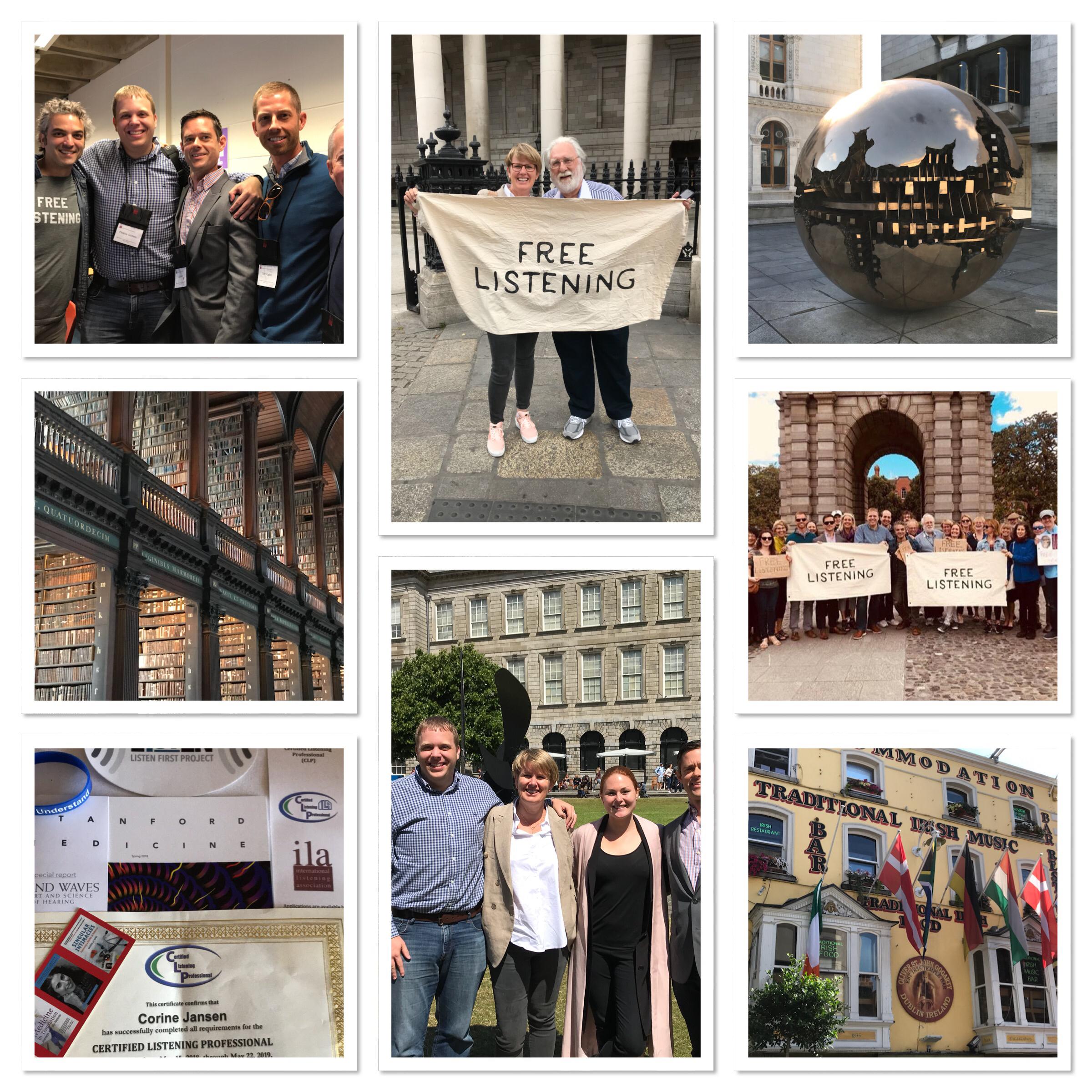 Photos: Corine Jansen
Benjamin Mathes, Pearce Godwin, Graham Bodie, Tom Kaden, Michael Gingerich, Corine Jansen, Richard D.Halley, Irene Göttgens and many ILA Listening Friends…
I attended fascinating and very moving presentations and listened to beautiful concerts! People shared genuinely on how listening, or the lack of it, was the core of their health, relationship, family or business experiences.
I personally learned about how to listen beyond emotional boundaries in difficult conversations or when too much enthusiasm is overwhelming! I’ve made some great discoveries about the Irish harp, its music, its history and how harp makers listen to build. I’ve seen school students ready to learn how to be better listeners providing we know how to tickle their interest. One presenter developed a model for such a class that could be spread all over the world.
Listening in health care is a subject in itself, in particular how we as patients are listened to by health care people and what we could do to have conversations enhanced by better listening, for the benefit of everyone.
Another interesting topic explored how our brain works hard to process the information effectively while at the same time struggling against the amount of internal noise we permanently have in our mind.
We also learned how organizations can establish a Listening Culture, and how to give the gift of listening wherever we are by holding a simple cardboard sign that says, “Free Listening”.
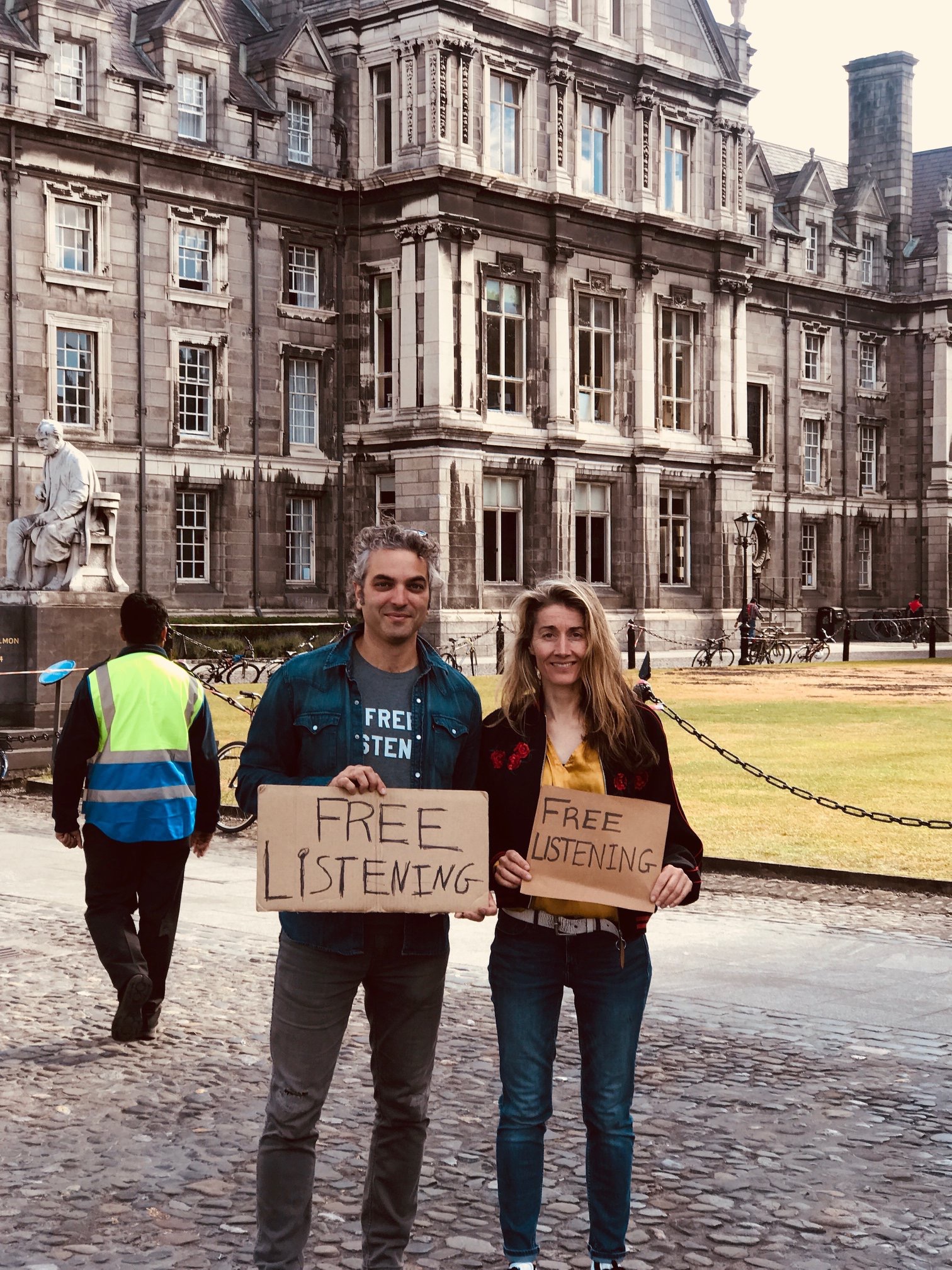 Photo: Urban Confessional
Benjamin Mathes (Urban Confessional Free Listening) and Helena Walsh (Helena Walsh Voice Studio)
To get an idea of the huge variety of presentations on listening, see the program here
Convention Full Digital Program
Convention Program Descriptions with Presenter and Co-Author Bios
I had the privilege to present on my favorite subject, the parallels between listening to music and listening to people. The title of my presentation was “When you speak, you sing!”. It was an interactive talk, where participants could experience the effect of listening to the music in each other’s voice.
I was honored to have an audience of researchers, authors, teachers with a life-time of experience on the subject of listening. I enjoyed sharing my work with them and getting their insights. In every corner, room, corridor, park, pub, at lunches and banquets I found opportunities to have meaningful conversations that raised my understanding and skills in the field of listening.
After attending an ILA Convention, you won’t say that listening is “important”. You will say it’s “essential” to our survival and our life on this planet as an undivided human species. And you’ll feel an inner urge to take action on spreading the message.
Jean Francois Mathieu
Music Composer
Listening Culture Designer at Leaders Today
Chair of the ILA International Day of Listening 2018
The next important ILA event is the International Day of Listening, September 20. Any of your ideas to make it a memorable day is welcome, just contact me.
info@jfmathieu.com
www.internationaldayoflistening.com
Discover the International Listening Association at www.listen.org
A gold mine of information and even more if you become a member.
Leaders Today is honored to be an affiliate partner of the ILA
www.leaderstoday.co/listen-lead
Contact us for a Talk or a Workshop in your organization
contact@leaderstoday.co
#LeadersToday #InternationalListeningAssociation #DayOfListening #listening @DayOfListening

Vous seriez surpris de voir combien de chefs d’équipe et de managers n’aiment pas vraiment les réunions. C’est l’un des défis les plus fréquents auxquels font face nos clients en coaching de leadership. Certaines personnes ont une aversion pour les nombreux aspects de l’expérience de groupe et peuvent se sentir extrêmement inconfortables si elles ont la responsabilité de convoquer et de diriger la réunion.
Si c’est votre cas, rassurez-vous, une réunion n’est pas destinée à être un one-man show! Tout ne doit pas reposer sur vos épaules! Une réunion au travail est une rencontre de plusieurs esprits, un effort de collaboration où la contribution de chacun fera avancer le groupe. Alors, mettez votre chapeau de leader coach, prenez un peu de recul pour une fois, permettez aux autres de faire leur part et détendez-vous!
Assurez-vous de demander à vos membres de l’équipe plus réservés ou introverti qui hésitent à s’exprimer (cela pourrait inclure vous-même!), de préparer au préalable un point précis de l’ordre du jour, afin qu’ils puissent intervenir plus facilement pendant la réunion.
En tant qu’organisateur de la réunion, vous allez probablement ouvrir la session, définir un cadre et annoncer l’ordre du jour. Vous pouvez décider d’attribuer des rôles à ce stade si vous ne l’avez pas déjà fait (par exemple, qui prendra les notes pour le compte-rendu, qui sera le garant du temps, etc.).
Ensuite, en posant certaines de ces questions, vous pouvez laisser le choix à votre équipe du processus à utiliser durant la réunion , et vous pouvez leur passer le bâton pour la co-création du contenu.
Ce ne sont que quelques exemples de questions qui structurent les conversations et invitent de nouvelles idées pour rendre votre réunion plus efficace. Vous en aurez certainement beaucoup d’autres adaptés spécifiquement à vous et à la situation de votre équipe.
L’idée est que vous abandonniez le sentiment de devoir tout assurer, et que vous laissiez l’intelligence collective du groupe émerger à travers un processus de questionnement ciblé et méthodique. Cela ouvre un espace pour le dialogue, la co-création et l’autonomisation des membres de votre équipe qui seront très heureux de contribuer et d’avoir leur idée accueillie comme une contribution précieuse au travail d’équipe.
Le coaching est une méthode de conversation guidée par une enquête stratégique qui stimule une réflexion novatrice. Cette conversation peut être entre deux personnes, ou en groupe, ou peut même prendre la forme d’un dialogue interne dans le cas de l’auto-coaching.
En d’autres termes, en posant des questions, vous prenez le temps de réfléchir, et plus précisément, poser des questions – plutôt que de sauter aux conclusions – dévoile de nouvelles perspectives.
Si vous ne posez pas de questions, vous continuerez à avoir les mêmes pensées. Les questions déclenchent de nouvelles pistes d’exploration et fournissent également un moyen de structurer la pensée.
Alors mettez votre chapeau de coach, détendez-vous et commencez à questionner plutôt qu’à dire!
Laissez les autres venir avec leurs idées afin que vous n’ayez pas à vous mettre sous la pression d’être le fournisseur éternel de la solution parfaite en tout temps!
Dites-nous comment vous vous en sortez avec la gestion des réunions, postez un commentaire ou une question dans la case ci-dessous!
© 2018 Saba Imru-Mathieu
Saba est responsable des initiatives de développement organisationnel, de la mise en œuvre de la culture du coaching et des programmes de coaching et d’éducation de Leaders Today. En tant que partenaire fondateur, son travail est axé sur le développement de leaders internationaux, la promotion de la collaboration dans les lieux de travail multiculturels et l’amélioration des compétences de coach au sein des organisations mondiales.

You would be surprised how many team leaders and managers really dislike meetings. This is one of the most frequent challenges that my leadership coaching clients face. Some people have an aversion towards many aspects of the group gathering experience and it can become excruciatingly uncomfortable if they have the responsibility to convene and lead the meeting.
If this is your case, rest assured, it doesn’t have to be like this. A meeting is not meant to be a one-man show! It doesn’t all have to rest upon your shoulders! A meeting at work is a meeting of many minds, a collaborative effort where everyone’s contribution will move the group forwards. So, put your leader coach hat on, take a little bit of a back seat for once, empower others to do their bit and relax!
Ask yourself these questions to prepare your meeting:
Make sure to ask your more reserved or introvert team-members who are reluctant to speak up (that could include yourself!), to prepare for any specific agenda item beforehand, so that they can more easily intervene during the meeting.
As the convener of the meeting you will probably open the session, set a framework and announce the agenda. You might decide to assign roles at this point if you haven’t done so beforehand (e.g. minute writer, time-keeper, etc.).
Then you can hand over the choice of what meeting process to use and the content building to your team by asking some of these questions.
Meeting process/methodology
Building content during the meeting
Follow-up
These are just some examples of questions that structure conversations and invite new ideas to make your meeting more effective. You will certainly have many more that are adapted specifically to you and your team’s situation.
The idea is for you to let go of having to run the show, and instead let the collective intelligence of the group emerge through a targeted and methodical question asking process. This opens up space for dialogue, co-creation, and empowerment of your team members who will be very pleased to contribute and have their contribution welcomed as a valuable input to the teamwork.
Coaching is a method of conversation driven by strategic inquiry that stimulates novel thinking. This conversation can be between two people, or in a group, or can even be in the form of internal dialogue in the case of self-coaching.
In other words, by asking questions, you create some time to reflect on the issue at hand, and more specifically, asking questions — rather than jumping to conclusions — unveils new perspectives.
If you are not asking questions, you will continue to have the same thoughts. Questions trigger new avenues of exploration and they also provide a way to structure thought.
So put your coaching hat on, relax and start asking rather than telling!
Let others come up with their ideas so that you don’t have to put yourself under pressure to be the eternal provider of the perfect solution all the time!
© 2018 Saba Imru-Mathieu
Saba is responsible for organizational development initiatives, coaching culture implementation, and the coaching and educational programs at Leaders Today. As the founding partner, her work focuses on developing international leaders, fostering collaboration in multicultural workplaces, and advancing the skills of coaches within global organizations.

Many people ask me for tips on what to read to learn more about coaching and leadership. So, I’ve decided to make a series of short videos, so you can meet the books on my bookshelf, and maybe get inspired too read them too!
Here’s the first video of “Meet my Books”, introducing Sir John Whitmore’s book Coaching for Performance.
 Leaders Today Blog