• Leadership is for everyone, every day!
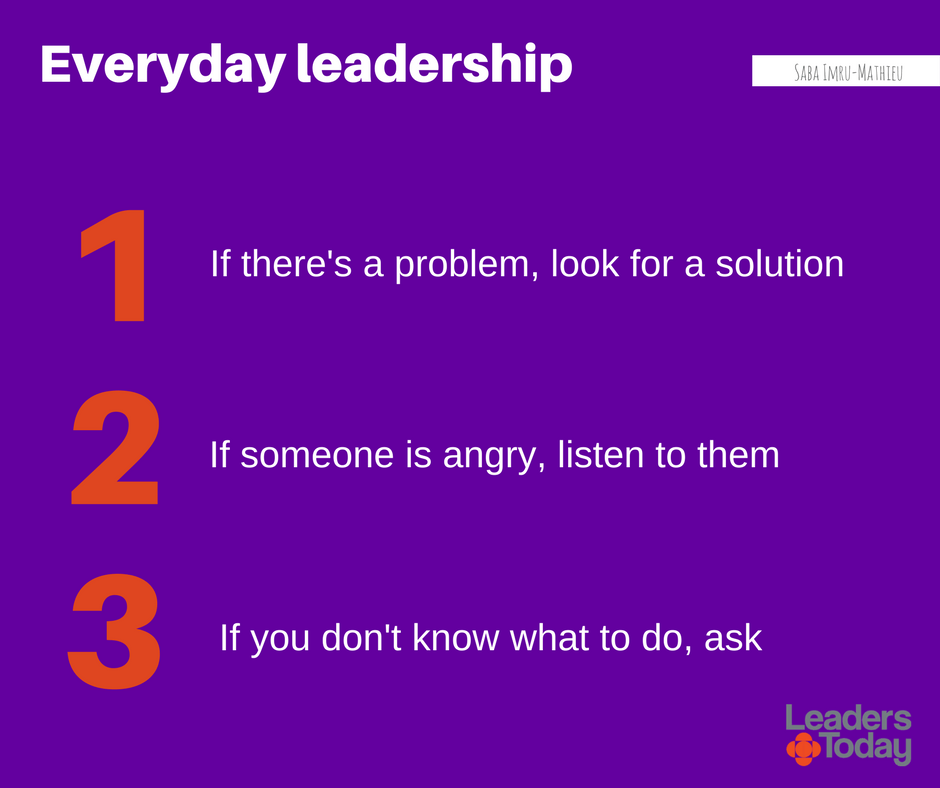
    Everyday Leadership sign

    Leadership is something we all express in our lives, most often without realizing it.

    When was the last time you took the initiative to organize an event at work, or for your family? You probably had to harness the help of other people and find creative solutions to any hurdles you faced. Maybe you had to make a risky choice, or calm down an argument or convince someone that it was worthwhile to make an effort. You probably took the time to acknowledge and thank those who helped you. There’s a good chance that you made new friends in the process.

    These behaviors all derive from your innate leadership capability, and if you cultivate them consciously, you can grow them into a battery of powerful skills with which to advance in life and at work.

    Here are three essential leadership skills that seem simple and obvious, but are sometimes hard to put into practice.

    1. If there’s a problem, look for a solution

    Being solution-focused doesn’t necessarily come easy.  It is very tempting, when facing a problem, to spend an excessive amount of time hand-wringing, analyzing what is going wrong, finding who’s to blame and perhaps wallowing in self-pity.   As part of our survival instinct we humans are hard-wired to notice the negative, spot possible dangers, dissect problems and dwell on their consequences.

    We know from cognitive psychology that people process negative information more thoroughly and for a longer period than they would positive information. Simply said, a problem is a magnet for our attention. While the negative feelings that emerge from observing a problem may initially provide an impetus to resolve it, the downside is that if we focus too long on the problem, we risk causing a prolonged high stress level within ourselves, which in turn hampers optimal cognitive performance.  Yes, we think less clearly when we’re stressed out so it’s not really the best place to be for effective problem-solving.

    Expressing leadership when facing a problem requires being decisive. It means analyzing the problem thoroughly but quickly  and then mobilizing all and energy to find a solution and move on.   After all, there is no shortage of next problems that might come our way in life, so it’s in our interest to develop a strong solution focus and grit for problem-solving.

    1. If someone is angry, listen to them

    An angry person makes us cringe!  The first instinct is to get out of their way and if that’s not possible, the second strategy is to try and silence them.  But anger doesn’t go away that easily if you try to repress it.  Have you ever tried telling an angry person to calm down? It doesn’ t usually go down very well!  There’s a reason for this, anger is often a sign that someone has something important (to them anyway) to express.   It may be frustration, disappointment, outrage. You might think it is justified or not, but whatever it may be, it reflects that something has not been heard under normal circumstances so the angry person needs to “shout” it out.

    Expressing leadership in such situations implies having a certain degree of self-control to weather the storm, and giving a clear signal to the angry person that you are willing to listen to their woes (not forever though!).  Once they’ve done some venting, you might even ask them what they would like, how they want the situation to evolve.    You’ll be surprised how a bit of good, sincere listening can quell a fury.

    3. If you don’t know what to do, ask

    “I don’t know” can be a hard phrase to say.  Whether it’s at school or at home and especially in corporate life, where there is a huge pressure on people to unfailingly come up with an answer to everything, finding yourself in  situation where you don’t know what to do might feel very uncomfortable. And asking for help or advice might seem even more scary.    Many people are reluctant to admit they don’t know something for fear of being seen as incompetent.

    But actually, there is great strength (and honesty) in displaying some vulnerability. In the last two decades new leadership models have emerged  arguing for more authenticity and higher levels of transparency as essential elements for building the trusting relations that are needed to succeed any enterprise where more than one person is involved. You’re far better off admitting that you don’t know, rather than pretending that you do because people can tell if you’re uncertain, vacillating or simply waffling about something.   It’s a bit like the story of the Emperor’s clothes!  Instead, people will respect you deeply if you are candid and humble, and they will trust you all the more for it.

    Asking for help or advice when you don’t know also makes sense in terms of leveraging the collective intelligence of the people around you which often results in a better solution than you could have come up with on your own.

    Mastering these three skills will help you express your leadership in any situation, at work or at home, whether you supervise other people or not. You will become solution-focused rather than getting stuck when difficulties arise. You will manage conflict with calm and assurance. You will show up as authentic and someone who can be trusted.

    In conclusion, leadership is not really about being a boss, it’s about the way you behave when facing the challenges of life everyday at home and at work. It’s about living up to your values and letting your natural bravery guide you in difficult moments.


  • Ecouter c’est prendre des risques !

    IMG_0202

    Je dirais même plus: de très grands risques!

    Je ne parle pas des risques engendrés par le fait d’avoir les écouteurs sur les oreilles toute la journée, ni d’écouter aux portes, ni de mettre quelqu’un sur écoute.

    Je parle de décider de mettre toute votre attention pour écouter quelqu’un.

    Cela va vous amener à changer au moins un de vos comportements. Vous risquez de voir vos croyances négatives préférées s’effondrer à vos pieds, et même de comprendre votre pire ennemi.

    Ecouter la Nature peut vous apporter la paix intérieure et détruire votre stress. La Nature peut parler directement aux cellules de votre corps et de votre cerveau sans que vous en ayez conscience. Ça fait peur, non?

    Ecouter la musique peut guérir la mauvaise humeur que vous avez mis si longtemps à peaufiner.

    Ecouter les animaux peut créer en vous des sentiments d’amour complètement déraisonnés, faire craquer votre carapace émotionnelle, faire fondre votre coeur et développer votre instinct maternel même si vous êtes un grand et solide gaillard.

    Ecouter votre partenaire peut éliminer les disputes ou remplacer les conflits par des surprises et découvertes! (ah bon?! mais qui pourrait possiblement vivre sans disputes?).

    Ecouter votre monde intérieur peut faire surgir des rêves de succès non désirés. Attention! Vous pourriez ressentir une force urgente à faire des changements dans votre vie personnelle et professionnelle.


    Comment pouvoir survivre à tous ces dangers?

    Vous pouvez empêcher tous ces changements d’intervenir dans votre vie bien réglée par simplement NE PAS écouter les autres êtres vivants ni les sons qui vous entourent.

    Vous pouvez aussi faire semblant d’écouter en souriant et en hochant votre tête pendant que tous ces sons dérangeants entrent par une de vos oreilles. Ensuite laissez-les contourner votre cerveau et s’évaporer dans l’air.

    Puis, lorsque vous prendrez votre retraite, vous pourrez vous réjouir à écouter tout ce bruit interne que vous avez développé à ne pas écouter les autres,

    ni vous-même.


    4Linkedin-SabaJF-Business-3-small50


    “Ears can go where eyes can’t see”


    Jean-François MATHIEU (jfm) mars 2017

    Music composer, improviser, producer, teacher, Listening Culture Designer

    Contact, détails et plus sur notre programme Listen and Lead à http://www.leaderstoday.co/listen-lead-fr

  • Staying focused while facing obstacles

    focus-with-logo

    It’s so easy to get distracted.  And when you’re not looking at what you want to achieve, when your attention is drawn to things that do not contribute to your goal, then you slow down and you might even stop altogether.

    In my years of coaching in organizations I have noticed that people spend a tremendous amount of energy thinking about what others have done that they don’t like or what others have not done that they thought they should have done.

    This kind of thinking can really distract you and get you stuck in a rut where you lose touch with what  you want to be doing with your work and with your life.  There are often good reasons for losing focus. Some of the most common that I have encountered are:

    A feeling of injustice.  If people feel they have not been treated fairly, this  is something they might fix on for a long time, even years, until it is resolved (which is seldom the case in the corporate world),  losing track of the other important goals in their life.

    Ending up in the wrong job.  Sometimes the job you applied for is not the one that you get, circumstances change and you might end up doing tasks for which you are not cut, or simply don’t like, or where you’re not using your skills.  This disappointment can lead to a lot of mulling  and again, losing track of what your important goals are.

    A bad relationship at work.  This is a real spoiler that can upset every waking hour of your work life.  Whether it’s a bad relation with a boss, a team-member or a peer, a relationship turned sour will certainly occupy your mind and deflect your attention from what is really important to you.

    These are all complex situations, and of course it is not easy to just dismiss them.  But you can put them to the side, or on hold if you will, while you take a breath and give yourself the opportunity to gain the helm of your ship again. Because after all, there is nothing more important than living according to your values, going in the direction that you want and fulfilling your dreams, whatever they may be.

    The most valuable step to take is to reconnect with what really matters

    When I work with coaching clients who are stuck in such a situation, we spend a good amount of time redefining and reconnecting to what is truly important for them, what do they really want at this stage of their life, personally and professionally, what are their priorities, what are they willing to invest all their energy into, what do they consider is “worth it”?  Once they have captured a sense again of what really matters to them , they can look at the situation that is causing the “stuckness” and re-evaluate it.  It might have changed shape, size, weight, clarity, importance…..

    Then, taking action becomes a possible option

    At this point they can think of what they might do about it, rather than let it parasite their existence.   We’ve thus moved into a more proactive approach.  There are as many different options for action as there are people, but typically they revolve around one of these:

    • Do everything possible to resolve it.
    • Find the positive in the negative.
    • Try to resolve it and if it doesn’t work, let it go.
    • Let it go, turn the page, move on.

    Whatever action is chosen, a shift has taken place,  a refocusing on important matters, a prioritization.

    That’s what  I like to call empowerment.  It’s not only about understanding that we have a choice, but it’s the enactment of that choice, even with a small step, that sets everything into motion again, from stuck to alive, from weighed down to soaring.  It’s when people get up, and actually take a step in the direction of where they want to go, when they make that phone call, have that conversation, take that decision, that’s when they know that they’ve focused again on their most important goal and they can move towards it with focus and single-mindedness.

    Focus on your goal and keep moving!

    Staying focused is essential to attaining your personal and professional goals, building your dreams. Focus creates energy. When things around you seem foggy, focus creates a direction. It helps you decide what counts and what doesn’t. It clears the road of unnecessary distractions. It keeps you moving towards what you want.  Now that’s worth trying out!


    24verysmall - Copy

    Saba Imru-Mathieu is an Executive Leadership Coach and Senior Coach Trainer who works with global organizations.  She holds a Masters degree in leadership studies and her current doctoral research focuses on how coaching capabilities contribute to global leadership.


    ©2016 Saba Imru-Mathieu, Founding Partner, Leaders Today
    www.leaderstoday.co
    Sign up to our free newsletter to get leadership and coaching tips

  • “International Day of Listening”

    Listening Earth LinkedIn

    Hello Listeners of the World,

    Hey! Have you heard? The whole world will be listening Thursday September 15 on this first “International Day of Listening” being created and sponsored by the ILA-International Listening Association.

    The world definitely could use more listening right now – and you too can be part of this!


    We are more than delighted to participate to this event by suggesting an exercise you can do to increase your listening awareness and your ability to focus.

    « When am I listening or being listened to »?

    oreille-poisson


    Please take a look at the website

    www.internationaldayoflistening.com

    and find out about how “Listening Makes Us More Human.”


    Spread the word to your friends, family, colleagues, and anyone else who would be interested in participating.

    Get the word out through your email contacts and social media sites, like us on Facebook and Twitter #Listenup2016

    And pass the website and any appropriate information on to the schools in your area, to local government, local businesses, organizations, churches, journalists, etc.

    « Be part of the conversation! »


    There are lots of ways to celebrate listening, so let’s get started telling the world to become all ears for International Day of Listening!


    Jean-François Mathieu (jfm)

    jf@leaderstoday.co

    www.leaderstoday.co


    ILA www.listen.org

    ILA logo horiz

    Sheila Bentley, Margarete Imhof, and the IDL organizers.

  • Coaching skills, the fast lane to soft skills

    road

    Soft skills are in high demand, whether you are an aspiring candidate, just inside the entry point threshold or a seasoned manager. There are so many definitions of soft skills that the concept can be somewhat elusive. You might say they include effective interpersonal communication, empathy, social graces, ability to resolve conflicts, solution-focus, positive attitude,  likeability, self-motivation,  and ability to influence.

    Those who are not inclined towards them refer to this “touchy-feely stuff” with some apprehension.  If you’re not really sure about how to acquire soft skills, learn how to coach.  You will forge the right mindset and easily master the behaviors that are indicators of a high mastery of soft skills.

    To start with, as a coach you will learn how to listen.  Really listen. That means silencing your busy, talkative mind, suspending judgment and holding an inner quiet that will enable you to hear everything that the other person is saying, including what they are not saying.  You will convey a message that you are interested in what they say, that you care about their ideas. Listening is the most powerful of all soft skills.

    As a manager who coaches you will observe that everyone can develop and grow. You will build up a positive mindset and a firm belief in other people’s (and your own) potential which is the best way to motivate them to reach for even more than they had ever thought was possible.

    The more you listen attentively to people, the more they will feel welcomed and acknowledged. The more you show confidence in others’ potential and help them grow it, the more you will be appreciated for your leadership. By listening attentively,  you develop empathy and your likeability factor will certainly get a boost – even if that’s not what you were looking for!

    Coaches ask lots of thought-provoking questions so that their coachee can think through their issues.  As you learn how to ask powerful questions, you will become more and more adept at helping others to identify solutions and find new perspectives.   As you realize that the question-asking process really works, you will develop a positive solution-focus and you will resolve your own challenges with the same questioning strategy.

    Lastly, when you learn how to coach, you will become familiar with many coaching tools that help you support the person you are talking to through difficult work situations, such as conflict with colleagues, a difficult choice to make, or lack of self-confidence to accomplish a task.

    If as a manager you’re timid about approaching the “touchy-feely stuff”, then learning how to coach will enable you to do so naturally, with competence, and assurance.

    These are only a few ways in which learning coaching skills can help you acquire soft skills effortlessly, without even noticing that you have!


    24verysmall - Copy

    Saba Imru-Mathieu is an Executive Leadership Coach and Senior Coach Trainer who works with global organizations.  She holds a Masters degree in leadership studies and her current doctoral research focuses on how coaching capabilities contribute to global leadership.


    ©2016 Saba Imru-Mathieu, Founding Partner, Leaders Today
    www.leaderstoday.co
    Sign up to our free newsletter to get leadership and coaching tips

  • Comment dit-on “leadership” en français?

    bigstock-Think-About-Leadership-39370759

    Une traduction insaisissable

    Le mot leadership est presque intraduisible.  Les dictionnaires que j’ai consulté me donnent différents résultats : parfois ils se réfèrent à des groupes de personnes: “les dirigeants”, “la direction”,  “l’état major”; ailleurs on pointe des capacités personnelles  “les qualités de meneurs d’hommes”, “l’aptitude à diriger”. Peut-être la traduction la plus exacte est celle d’un dictionnaire sur Internet, qui nous dit qu’en français le mot “leadership” se dit ….. “leadership”!

    Mais comment saisir le concept derrière ce mot?  J’ai souvent entendu décrire quelqu’un qui a une forte personnalité, qui est capable d’imposer sa volonté, comme étant quelqu’un qui a “beaucoup de leadership”. On associe le leadership avec une force plutôt subjuguante, à la capacité de faire faire des choses aux autres.  J’ai même eu un participant à mes ateliers se vanter d’être un vrai leader car personne ne pouvait s’opposer à lui !  Il n’est pas le seul à penser qu’un leader doit commander l’obéissance, voir même la peur. D’où vient cette fausse idée, ce grand malentendu ?

    Il y a eu un grand nombre de théories sur le leadership, chacune avec sa définition. Les anciens modèles de leadership – heureusement désuets –  reposaient sur les traits personnels du supposé leader, en décrivant une espèce de super-homme (et c’était vraiment au masculin !), avec des qualités de meneur innées y compris sa taille (il était de préférence grand).

    Aujourd’hui nous avons une autre vision du leadership, basée sur des décennies de recherche scientifique dans le domaine.  Voici quelques principes essentiels pour donner un éclairage sur ce thème parfois mal compris.

    Principe no. 1

    Le leadership est un processus par lequel un individu influence et inspire d’autres personnes à agir ensemble vers un but commun. 

    Trois concepts ressortent de cette définition. Premièrement, le fait qu’il s’agit d’un processus et non pas de traits de personnalité nous indique que le leadership peut être exprimé par tout le monde, et qu’il peut être appris.

    Deuxièmement, quand on est leader, on influence et on inspire. Dans le leadership il n’y a aucune notion d’autoritarisme ni de contrainte. Au contraire, le leader est au service des autres pour les élever à être au maximum de leur aspirations et de leurs capacités.  (Ceux qui aspirent à être “leader” pour commander, avoir du pouvoir sur les autres et nourrir leur propre égo sont plutôt des candidats pour les postes de dictateur.)

    Enfin, le leader n’habite pas dans une tour d’ivoire lointaine. Il est impliqué à fond dans le mouvement vers l’objectif commun, il est étroitement engagé dans l’action, il donne des signes visibles d’être ensemble avec les autres. Le leadership signifie donner l’exemple, être congruent et présent.

    Principe no. 2

    Les leaders dans les organisations ne sont pas uniquement ceux qui sont dans des positions d’autorité.

    Le leadership s’exprime à tous les niveaux organisationnels chaque fois que quelqu’un prend en charge un projet, une initiative, une situation d’urgence qu’il faut régler rapidement.

    Ce n’est pas rare qu’une personne ayant le titre de chef ne soit pas du tout inspirante, alors qu’un employé du bas de la hiérarchie se soit montré capable de mobiliser toute une équipe à faire des efforts extraordinaires.

    Les organisations qui favorisent un leadership partagé et distribué sont celles qui savent utiliser les talents de chacun des employés tout en leur permettant d’exprimer leurs capacités.

    Principe no. 3

    Le leadership est relationnel, et cela ça s’apprend.

    Il ne suffit pas d’avoir des diplômes et d’excellentes connaissances techniques.  Le savoir-faire dans les relations humaines est essentiel, ainsi que la connaissance de soi et la capacité à s’auto-gérer. La vision stratégique doit être accompagnée d’empathie, de compassion et de la capacité à établir des relations de confiance avec son équipe.

    La bonne nouvelle est que tout cela peut s’apprendre. Il s’agit de développer ses “soft skills” (autre mot intraduisible !) et pour cela il faut juste le vouloir.

    Alors, détendez-vous

    Ces quelques principes sont issus de la recherche sur le leadership des 50 dernières années, et des études menées à travers le monde.  Tous indiquent que le leadership qui produit de bons résultats et crée de la valeur dans la société, est fondamentalement bienveillant.

    Alors si vous voulez être un leader, détendez-vous, pas besoin d’être autoritaire ni d’imposer vos vues à tout prix. Vous pouvez rester authentique, que vous soyez extraverti ou d’une nature plutôt réservée, cela n’a rien à voir avec le leadership. Le plus important c’est de créer des relations de confiance avec votre équipe en étant fiable, courtois, intègre et bienveillant.

    Vous pouvez en toute sérénité renoncer à vouloir tout contrôler, soyez plutôt à l’écoute, donnez de la place à vos collaborateurs afin qu’ils expriment leurs idées, leurs talents et aussi leur leadership.

    En vrai leader, osez vous mettre au service de votre équipe afin de réaliser ensemble les projets qui vont vous faire tous progresser.  C’est ça le leadership du 21 siècle. Il s’agit de reconnaître l’humanité et l’autonomie de chacun et pour ça, il n y a pas besoin de traduction!


    Références:  C’est impossible de vous donner une liste exhaustive des oeuvres sur le leadership dans ce court blog, mais voici quelques titres intéressants :

    • La belle histoire de Favi : l’entreprise qui croit que l’homme est bon, Zobrist Jean-François (2014)
    • Reinventing organizations : Vers des communautés de travail inspirées, Laloux, Frédéric; Poirieux, Gilles (2015)
    • Authentic Leadership: Getting to the root of positive forms of leadership (in Leadership Quarterly), Avolio, Bruce; Gardner, John (2005)
    • Transformational leadership, Bass, Bernard M.; Riggio, Ronald E. (2005)
    • The Servant as Leader , Greenleaf, Robert (1970)
    • Appreciative inquiry. A positive revolution in change, Cooperrider, David; Whitney, Diana Kaplin (2005)
    • Resonant Leadership. Renewing yourself and connecting with others through mindfulness, hope, and compassion, Boyatzis, Richard; McKee, Annie (2005)
    • The What, Why and How of Management Innovation (in Harvard Business Review), Hamel, Gary (2006)
    • The future of management, Hamel, Gary; Breen, Bill (2007)
    • The leadership challenge, Kouzes, James M.; Pozner, Barry Z. (2007)
    • Care to Dare: Unleashing Astonishing Potential Through Secure Base Leadership, Kohlrieser, George (2012)

    24verysmall - Copy

    Saba Imru-Mathieu is an Executive Leadership Coach and Senior Coach Trainer who works with global organizations.  She holds a Masters degree in leadership studies and her current doctoral research focuses on how coaching capabilities contribute to global leadership.

    ©2016 Saba Imru-Mathieu, Founding Partner, Leaders Today
    www.leaderstoday.co
    Sign up to our free newsletter to get leadership and coaching tips


  • ECOUTE-VOIR !

    owl-twist

    Je ne suis pas satisfait des mots ou expressions employés en français pour décrire le « Listening ».

    En anglais « Listening » implique le désir d’écouter l’autre avec tous ses sens, son cœur, son esprit. C’est un effort, une action.

    Chinese-Listen-bw


    J’aime aussi le symbole chinois qui décrit l’action d’écouter en incluant l’oreille, l’autre comme si il/elle était un roi ou une reine, les yeux comme si on en avait dix, le un(l’attention indivisible), et le cœur (dont l’empathie).


    Dans ce sens, écoute active, écoute attentive ou écoute totale en français me sonnent comme des pléonasmes. Ecoute bienveillante me paraît un peu molle et proche de la condescendance.

     …

    J’ai aussi une impression de confusion dans l’emploi des mots ou verbes français : écoute, écouter, entendre, ouïr.

    On peut quand-même arriver assez proche du sens de « Listening » en employant des expressions qui ne contiennent pas forcément les mots ci-dessus, comme « je te prête mon attention ».

    En fait une expression qui reflète bien ce côté attentif et plus global dans l’écoute est notre expression Suisse Romande :


    “écoute-voir !”


    Comme elle est à l’impératif, je propose de la mettre à la première personne en s’adressant à l’autre : « vas-y, je t’écoute-voir ! »


    Qu’en pensez-vous ?


    4Linkedin-SabaJF-Business-3-small50


    “Ears can go where eyes can’t see”


    Jean-François MATHIEU (jfm) Juin 2016

    Music composer, improviser, producer, teacher, Listening Culture Designer

    Contact, details and more about our Listen and Lead programs on www.leaderstoday.co/listen-lead

  • What is Personal Development?

    J0285159


    What does the term “personal development” mean for you?

    Some people associate it with study and learning, for others it’s about acquiring new practical skills and for others still it evokes a quest for fulfillment or a spiritual journey. It is perhaps all of these, and more. Whatever the perspective, each reveals a common fundamental assumption that people can grow, that through deliberate effort, we can cultivate our basic qualities, develop our talent and learn a huge amount of things at any age. This is what Dr Carol Dweck, a leading scholar in developmental psychology, calls a “Growth Mindset” as opposed to a “Fixed Mindset” which supports the belief that intelligence is static and that once you have grown into adulthood, you are stuck with whatever skills you have, with little hope of significant improvement.

    Self-awareness

    Personal development starts with a keen interest in knowing oneself and understanding our own behaviour. If more people were self-aware, instead of functioning on automatic pilot, we might have more peaceful workplaces and more serene homes.

    The saying “know thyself” is frequently attributed to Socrates, although other Greek philosophers such as Thales and Pythagoras also held this precept. The importance of knowing oneself as a precondition for knowing the universe and greater truths has been vastly appreciated from antiquity up to modern philosophy. Many Eastern cultures encourage the path of self-realization, the knowledge of the self through direct experience. Today, we refer to this as self-awareness.

    Self-awareness is a thorough knowledge of oneself; how we function internally, why we do what we do and how we relate to others. It also implies the ability to change and grow, to manage our thoughts and behavior so that they are beneficial to our professional and personal life, and to others.

    Although the expression “self-awareness” may appear to be somewhat esoteric, it actually describes some very concrete skills that are accessible to everyone. The only pre-requisite towards gaining self-awareness is the desire to do so. Many unexpected aspects of ourselves are revealed through just a bit of introspection and self-observation.

    Beliefs

    For example, by taking the time to make a list of all the things you hold as truths, rules or realities, you will come up with a comprehensive (and sometimes surprising) catalogue of your beliefs. Your beliefs are important because they determine your thoughts and behavior.  Complete your list, then answer these questions:

    • Which of these beliefs are useful and sustaining?
    • Which of these can you discard?
    • What new beliefs can you adopt that will empower you?

    Inner dialogue

    Inner dialogue is another important aspect of self-awareness.  We are constantly having a conversation with ourselves.  Spend a few days carefully listening to yourself. Pay attention to all the little words and expressions that you whisper in your mind. You’ll be surprised at what you hear!  Then answer these questions:

    • What do you say to yourself all day long?
    • What phrases do you repeat over and over again?
    • Are you nice to yourself? Strict? Scolding? Encouraging? Lamenting?

    You can always improve on the words that you use in your mind. Any limiting words or phrase can be replaced by more resourceful ones.  For example, “I’ll never make it” can be replaced by “I’ll make it this time”.

    • In what ways could you improve the language of your inner dialogue starting today?

    Be aware of what you say and how you say it

    You may also want to be more aware of what you say to others and especially, how you say it. Observe yourself communicating in specific circumstances.

    • What is the tone of your voice? What is your body language?
    • What is the quality of your language….. constructive… indifferent…. sarcastic…. helpful?
    • How do you think you make others feel?

    This exercise will give you an insight into how you impact other people by your words. Perhaps you will realize that you want to improve your communication skills at work, the way you talk to your colleagues or clients. Or maybe you might discover that there’s room for improvement in the way you communicate with your family.

    Personal Development in the Work Place

    Personal development is extremely important in the workplace for the following reasons:

    • By increasing your self-awareness, you will have a better understanding about how you interact and react to others. This will result in improved interpersonal communication.
    • You will become more aware of what triggers your work-related stress and be able to implement tools to manage that stress.
    • You will realize what are the conditions under which you perform the best, and can try to replicate these.
    • You can learn what skill gaps you may have and create a learning action-plan to fill these gaps.
    • You will have better self-management and more strategic approach to developing your career.
    • Through enhanced self-awareness and self-management you will improve your leadership and your ability to influence others positively.

    You are the master of yourself

    The path to self-awareness does not require permanent self-contemplation! It just means that once in a while, you take time for yourself to look at what is really important and determine what you can do to move yourself forward.  Professionals can help you with strategies and techniques for gaining self-awareness however, there is only one person who detains all information about yourself and that is you. You speak and hear your inner dialogue. You are the owner of your memories and the master of your wishes. You know what you like and don’t like. You know when something feels right or wrong. You remember your past, interpret your present and create your future. It is all within YOU. You just need to tune in.

    www.leaderstoday.co

    Sign up to our free newsletter to get leadership and coaching tips

    ©2016 Saba Imru-Mathieu, Leaders Today

  • Music, the spoken voice and other sounds

    Tete de viole50

    A column by Jean Francois Mathieu

    “The Composer’s approach”


    INTRO

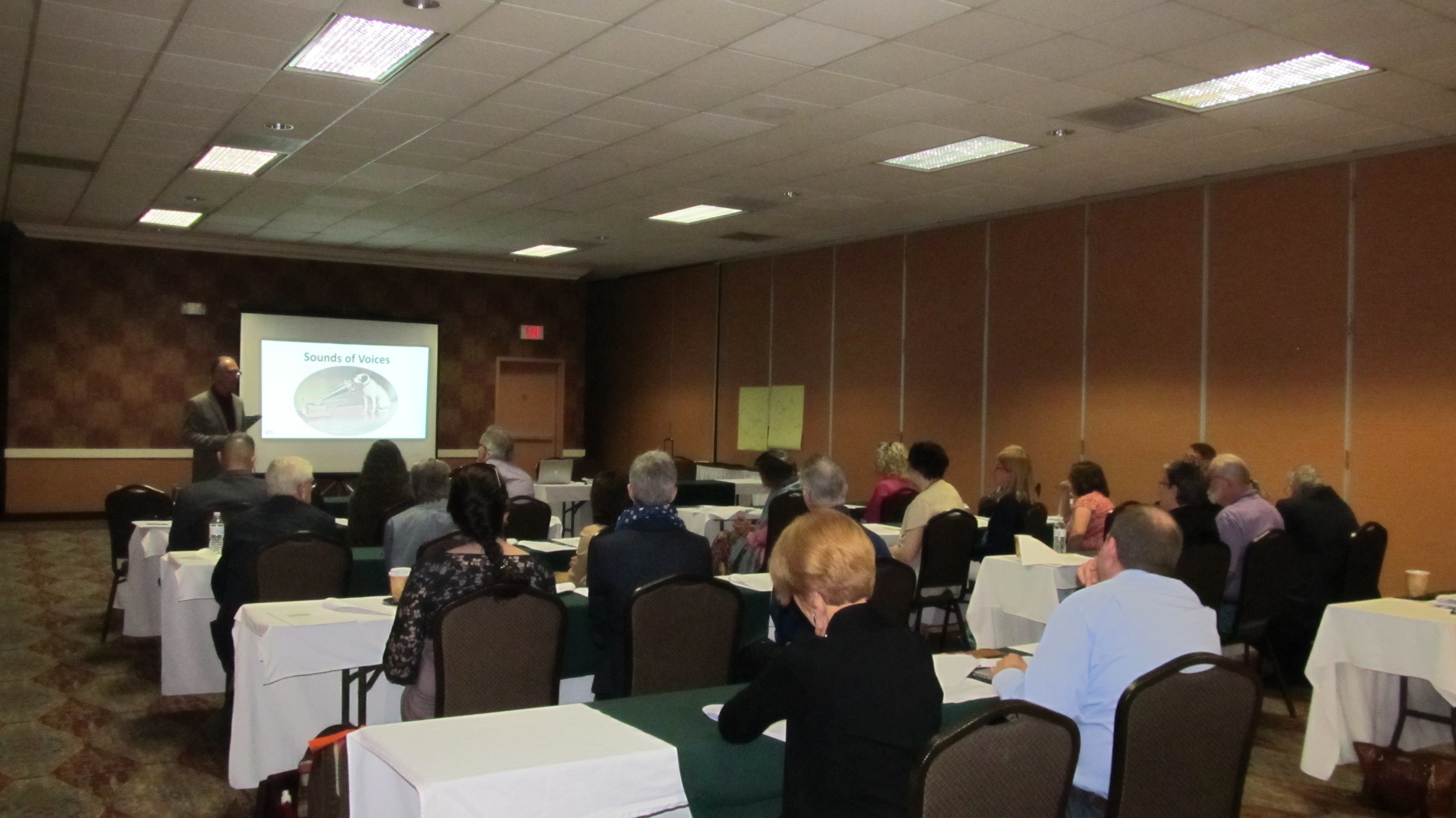
    Where there are listeners, we have to have sound(s) to listen to. In Tucson AZ April 12 at the ILA International Listening Association Convention there were plenty. Starting from the cascading fountain in the hotel’s patio, chirping birds in the trees, early bees announcing a warmer season and an air force parade in the desert skies.

    The most important of them all were the sounds of people attending this Convention. Welcome and moving talks at the luncheons, passionate presenters, laughs and forks during the meals, a strings orchestra, silences of quality, stimulating and meaningful conversations.


    MAIN THEME

    After having attended several outstanding sessions and given my presentation, I had very interesting conversations about listening to sounds, music, people and silence. Many ILA members are musicians or had fun with a musical instrument at a certain point in their life.

    In my presentation “Can Appreciative Listening be a way to (re)discover the motivation to listen to people?” one aspect attendees really liked is what I call

    “The Composer’s approach”

    Tete de viole50


    Listen to music as if it were a person

    Listen to a person as you would listen to a musical instrument


    As a composer, I’m constantly attuned to all the sounds the Universe is offering.

    I don’t have a specific purpose. I’m available. But I’m constantly in search of the “music” in what I hear (be it objects, music, nature or living beings). When I hear an interesting sound that could lead to a musical composition, I direct my attention to this sound. And music comes to me. Even in my dreams when I sleep.

    You may think it must be tiring.

    It can be tiring when I decide to listen with all my senses and undivided attention for a long period of time. But not much during my “normal” time. I think the many years I spent listening consciously to sound and music developed in me some sort of a reflex to interesting sounds. Maybe composers develop a special second reptilian brain that alerts us when a sound must absolutely be taken into consideration to figure in our next master piece  😉

    When I hear people, there are some “interesting” sounds in what they say that capture my attention. At times I’m a simple listener from a distance, in the same way I would be an observer of a situation, other times I am a part of the conversation and I spot interesting sounds along the way, in the same way I listen to music. This heightens my desire to listen and regenerates my alertness.

    When I listen to music, I perceive sounds and how these sounds are arranged together on several parallel channels (bass, drums, percussion, guitars, violin, strings, keyboards, synthesizers, horns and more, sometimes including human voice with or without words and meaning). It is multichannel listening.

    Be able to apply multichannel listening is an advantage when listening to the many components of the sounds produced when a person speaks (breath, melody, rhythm, dynamics, articulation, tone, silences…).

    What’s also interesting are the interactions between all these components as a means to perceive more of the message, be it music or spoken voice.

    Using this approach to listen to the sounds and aural language of a person is also useful when we can’t see the person and have to understand the meaning of the words. We can compare what we understand with the general idea we have through the sounds of the person. It can lead to finding congruence or discrepancies.

    This is what I suggest by: “the Composer’s approach”

    It is something that can be learned.


    CODA

    Approaching listening through the appreciation of sounds also teaches us the Art of Silence.


    AccCel_17 09 04_sbel (6)_CROP


    “Ears can go where eyes can’t see”


    Jean-François MATHIEU (jfm) April 2016

    Music composer, improviser, producer, teacher, Listening Culture Designer

    http://www.leaderstoday.co / http://www.jfmathieu.com

  • A Listeners’ Convention?!

    Laurel Hardy 2

    I was recently a speaker at the ILA International Listening Association Convention in Tucson AZ, presenting on “Can Appreciative Listening be a way to (re)discover the motivation to listen to people?”.

    After attending a first session as a participant, I quickly realized it was about sharing passion and knowledge far more than information and lectures. At this Convention I felt immediately welcome, warmly invited to contribute, that my voice made a difference and that I was listened to.

    ILA members are a very special audience. I’ve rarely been listened to with such attention. Everyone looks at you with the greatest interest and nobody fiddles with a pen or electronic device.

    It was an immense honor to have such experienced listeners amongst the audience, including some living legends of Listening, the authors whose books and papers I have read with great interest. They don’t have anything to prove. Despite their immense experience, they still are eager to learn. It was a lesson in real leadership and humility.

    Mathieu 4


    At this Convention I received many insights on Listening from so many angles, and I want to share some with you.

    One stunning observation that is recurrent these days is that many people, being used to communicating through electronic media, are afraid to meet and speak to a real person. It’s a problem for communication at large, between family members or peers at work, students among themselves… accentuated by the position, hierarchy or age. How can you meet the love of your life under these circumstances?

    One ILA member assists policemen in his district to help them to be more effective listeners. This helps greatly to replace violence by communication and understanding.

    We also observed that when you learn to be a more effective Listener, you become almost automatically a more effective speaker. You know how to present your material better for the Listener to have the maximum of comprehension and retention. You become “listenable”. And that’s what speakers want, don’t they?


     A listeners’ convention?

    Before leaving for Tucson, when I said I was going to a “Listeners” Convention, the joke I heard the most was “A listeners’ convention? But who’s talking? Hahaha!”.

    Believe me, these passionate listeners, researchers, authors and teachers have A LOT to transmit. And they won’t have to speak or write very long to make you realize that you may have missed one of the main components in communication!


     Good news! listening can be learned!

     If you missed the teachings of Ptahhotep 4000 years ago, or the writings of Plutarch 2000 years ago, and many others along the way, there’s a lot of comprehensible material nowadays to learn and practice Listening to assist you in bettering yourself, your family, your community… and the world at large.


    If you’re not satisfied with the way you listen or the way you’re listened to, it may be time to become aware of your listening behaviors.

     Before filling a complete listening assessment, start simply by drawing two columns (on paper or electronic…). Label the first one “When do I listen?” the other one “When am I listened to?”. At every moment of your day put a tick in the corresponding column. Too simple? You’ll let me know after just one day how your awareness on Listening has increased. Repeat the process for one week. Count the ticks. Compare one day with another.


    Another way to realize the importance of listening as a tool to attain very concrete goals is to ask yourself “When did I encounter these kind of situations (or similar)?”

     You’ve lost important information (or data, money, clients, providers, partners…) / someone lost yours.

     You’ve hurt feelings / you’ve been hurt.

     You’ve missed opportunities / you’ve made others miss opportunities.


     Learning to listen is not linear. Neither is the way we teach it.

    One way I sometimes approach teaching how to listen to people is the same way I teach listening to music. It all begins with sound. We call this “Appreciative Listening”. If you like the sound of what you hear you’re more inclined to make the extra effort to pay attention in order to understand.

    Whatever the approach, as soon as you become aware of the benefits of learning even just one listening skill, your overall listening effectiveness will take a leap forward!


    DCF 1.0


    “Ears can go where eyes can’t see”


    Jean-François MATHIEU (jfm) April 2016
    Music composer, improviser, producer, teacher, Listening Culture Designer
    Contact, details and links on www.leaderstoday.co/listen-lead